Howdy, Stranger!
It looks like you're new here. If you want to get involved, click one of these buttons!
Categories
In this Discussion
Book: Output by Lillian-Yvonne Bertram and Nick Montfort

Our featured book discussion is Output: An Anthology of Computer-Generated Text, 1953–2023, edited by Lillian-Yvonne Bertram, Nick Montfort. The book is co-pubished by The MIT Press and Counterpath Press, and available in paperback/ebook.
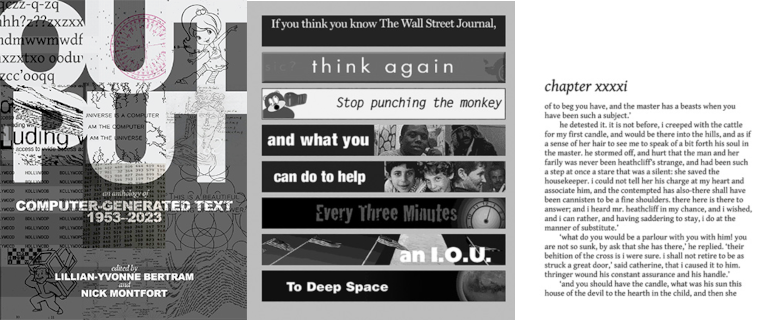
From the MIT Press:
An anthology of seven decades of English-language outputs from computer generation systems, chronicling the vast history of machine-written texts created long before ChatGPT.
The discussion of computer-generated text has recently reached a fever pitch but largely omits the long history of work in this area—text generation, as it happens, was not invented yesterday in Silicon Valley. This anthology, Output, thoughtfully selected, introduced, and edited by Lillian-Yvonne Bertram and Nick Montfort, aims to correct that omission by gathering seven decades of English-language texts produced by generation systems and software. The outputs span many different types of creative writing and include text generated by research systems, along with reports and utilitarian texts, representing many general advances and experiments in text generation.
Output is first and foremost a collection of outputs to be encountered by readers. In addition to an overall introduction, each of the excerpts is introduced individually and organized by fine-grain genre including conversations, humor, letters, poetry, prose, and sentences. Bibliographic references allow readers to learn more about outputs and systems that intrigue them. Although Output could serve as a reference book, it is designed to be readable and to be read. Purposefully excluded are human–computer collaborations that were conceptually defined but not implemented as a computer system.
This book is part of the new Hardcopy series edited by Nick Montfort and Mary Flanagan, which "features computational artworks that manifest themselves in print" and places itself in "the traditions of artists’ books, bookworks, and publishing as an artistic practice." We have previously discussed Daniel Temkin's Forty-Four Esolangs from the same series.
Hardcopy features computational artworks that manifest themselves in print. Works in the series engage with and arise from computation in culturally important ways. The series is a space for (among other things) books that are computer generated by artists and poets, whether they include text, image, or both; print works based around glitched media formats; ones that feature type-in programs with sample output; and ones arising from interaction with automated agents.
The publications presented in Hardcopy are themselves the primary artworks. A Hardcopy book is a literary art project, not a work of literary studies, for example. Rather than being catalogs for shows, publications in the series are more aligned with the traditions of artists’ books, bookworks, and publishing as an artistic practice. By presenting innovative and compelling projects, we aim to reveal the diversity of the computational arts —found in algorithmic and software art, electronic literature, digital gaming, the demoscene, livecoding, and generative systems—while also showing connections between historical, current, and emerging practices.
The Output anthology contains a provisional timeline of works (1953-2023) as an appendix, but it is organized instead by 15 topical sections arranged alphabetically: Conversations, Humor, Letters, Novels, Performance, Poetry, Prose, Reporting, Rhetoric Oratory and Lectures, Sentences, Storytelling, Text and Image, Tweets and Microblogging, and Words. One may browse these sections from the table of contents, look up a work by title in the index, or browse years in the timeline and look up the works listed there by their corresponding section heading.
In their introduction, Bertram and Montfort emphasize their principled methods of selection and engagement which eschew creating their own software-based generations in favor of previously available outputs:
In selecting the outputs that follow, although ones of this sort are omitted, we have promiscuously included text from research systems, natural-language generation products and services, and artistic and literary programs. We did not reimplement historical generators to produce the outputs in this book or even download and run programs. The texts here were all previously published in print or online or, in a few cases, were obtained simply by visiting a Web page. Whenever possible, we used the outputs that natural language researchers and author/programmers themselves presented to showcase their work.
For some key selected works appearing in Output, see also this writeup from The MIT Press Reader:
- "The Living History and Surprising Diversity of Computer-Generated Text: selections from 'Output,' an anthology showcasing seven decades of English-language machine-generated texts, long predating ChatGPT."
It includes:
- Random Generation of English Sentences (Victor H. Yngve, 1961)
- Fairy Tale Generator (Joseph E. Grimes, 1963)
- The House of Dust (Alison Knowles, 1967)
- Articulations (Allison Parrish, 2018)
- A Noise Such as a Man Might Make (Milton Läufer, 2018)
- Arria NLG (Arria NLG plc, 2019)
Especially relevant to Critical Code Studies is the editorial emphasis on next steps and "extending your engagement" after reading outputs -- in ways that may be quite familiar to participants in this CCSWG:
We chose to compile this English-language anthology because we knew of no resource like this one. Extending your engagement with the outputs here could be as easy as following a link, either to a working system online or through a bibliographic entry where a paper or article is available. There are already several excellent scholarly articles and books, and even some more popular writing, relevant to the topic of text generation overall. Pursuing those is a great next step for people fascinated with these outputs. Another way to deepen your involvement with text generators is to make one.
Comments
I love that in the only known output of the Fairy Tale Generator (Joseph E. Grimes, 1963), the Lion gets their possession back but is presumably still "in trouble."
Awesome (and valuable) book!
Thank you for this post, @jeremydouglass! I also very much appreciate what you quoted from the introduction at the very end of your post.
The anthology — in a format that we hope is familiar to many readers, even those not deeply engaged with computing — is meant to be a complement to and introduction to understanding code and processes directly. We wanted to invite people to explore what generated the texts in the book in many different ways, by reading academic papers, investigating and running working code, and critiquing such code.
We hoped to make several other interventions, including connecting literary and non-creative text generation in the 500 pages and 200 selections.
Perhaps most directly relevant to CCS, the book concludes with an executable Code/a — which you all are welcome to critique!
For those interested in taking up the invitation to dive into the executable conclusion to this book, I also posted a specific code critique thread here: