Howdy, Stranger!
It looks like you're new here. If you want to get involved, click one of these buttons!
Categories
In this Discussion
Week 3: Latin American World Model

This code critique is based on a contribution to the Source Code exhibit.
Authors: H. Scolnik, L. Talavera, I. Loiseau, M. Camuyrang, J. Perrez Iturrioz, E. Rocchi, C. Ruiz
Date: 1976
Language: Fortran
Source code
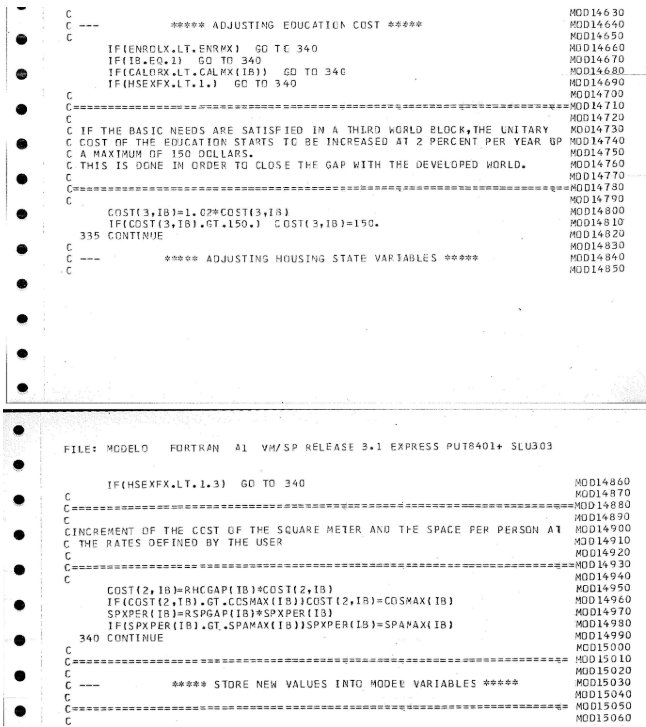
Context
Even in the early years of computer science, the idea that the world could be understood as a system that could be simulated by computers was already popular. Early digital simulations promised to understand and predict global trends acting as warning devices without offering ways to avoid their predicted futures. The LAWM (Latin America World Model), developed by a multidisciplinary team around Argentinian geologist Amílcar Herrera, deliberately tried to steer an early global community of world modelers toward solutions, not risks.With a focus on basic needs – like adequate housing, education or protein intake –, the model indicated a path towards optimal allocation of labor and capital to ensure the longest possible life expectancy. Their model showed that a global catastrophe was not imminent; with the use of optimization and planning, there were even ways for the less wealthy regions of the world to reach a standard of living as in the US or European countries.
The code is of double interest: it exemplifies both the grammar and lexicon of one of the earliest and most widely used high-level programming languages, Fortran, and the way computer programs are never neutral, but instead embody particular political visions.
Resources
- The Latin American World Model (a.k.a. the Bariloche model): three decades ago, a personal reflection by one of the authors.
- Catastrophe or New Society?: A Latin American World Model, the original publication around the LAWM
- SimPolitics: America’s Quest to Solve Politics with Computers, upcoming book by Fenwick McKelvey at MIT Press
Questions
- What role does Fortran (a Formula Translation language) play in translating concepts that are themselves beyond a formula (i.e. "basic needs")? As a response to the World3 model focusing on material realities, the LAWM proposes to focus on social and political factors: are one of these domains more amenable than the other to be translated into code "productively"?
- Is there some sort of isomorphism between the written code/running software relation and the model/simulation relation? Or is written code already a simulation of an existing conceptual model?
- How does the LAMW compare to World3 model, and what does that tell us of code's institutional ties in order to perform, not only mechanically, but also politically?
Credits
This source code excerpts has been contributed by Fenwick McKelvey and Markus E. Ramsauer.
Fenwick McKelvey is an Associate Professor in Information and Communication Technology Policy in the Department of Communication Studies at Concordia University. He leads “Machine Agencies” at the Milieux Institute. He studies digital politics and policy.
Markus E. Ramsauer is a PhD Candidate in the History of Science at the University of Vienna. Ramsauer investigates origins of global simulation models in relation to the Global South.
Comments
@période Amazing. Is there a link to the full FORTRAN code in a copyable form?
@période - love this - thank you- I remember being interested in how different programming frameworks (functional programming, OOD, agent-oriented design, etc) influenced their solutions.
Maybe this could be analyzed in a category-theoretic framework, or in a Don Idhe amplification-reduction post-phenomenological context - Fortran amplifies concepts that have measurements associated with them, and reduces those that do not - (e.g., wage labor vs caregiving/unpaid labor).
I would be curious to hear from anthropologists or historians of science on this.
For some reason, I am reminded of the cybersyn project in Chile:
https://en.wikipedia.org/wiki/Project_Cybersyn
Also, of the philosopher Eric Winsberg and his work on simulation.
The comment "THIS IS DONE IN ORDER TO" seems expressive of its intent in a way that reminds me of the literature programming tradition -- for example, if the FORTRAN code in this MODEL0 was found not to align with the comment block about basic needs and the cost of education, then, rather than modifying the comment to better reflect the code, the code would be altered to better reflect the comment.
I'm also reminded of the question of the true intent of code. In for example the "Climategate" code from the CRU, and other code-conspiracy-theories or code-moral-panics, the conflict is often between the idea that code implements a secret agenda (e.g., that acts of modeling are themselves necessarily algorithmically biased), and the idea that code is in fact conceptual, rhetorical, and a form for directly making arguments about the world (as is modeling) -- this is how needs, money, and education do / should / could relate. We might generally align this bifurcation around conspiracy-like and manifesto-like code with the hermeneutics of suspicion and the hermeneutics of recovery -- discovering the ways that code embodies (and perhaps conceals) manipulative power that must be critiqued, and/or discovering the ways that it embodies authentic ideals that should be recovered and preserved.
Mark, re: "the full FORTRAN code in a copyable form", I notice that the linked paper in Futures is from 2001, and that the exhibition page is only these screenshots. The original paper is 108 pages but no FORTRAN code. I tried searching Github for excerpts from the screenshots, e.g. "ADJUSTING EDUCATION COST" et cetera, and the Software Heritage Archive as well for strings, but no dice.
@markcmarino, @eon, that excerpt was contributed by Markus Raumsauer, and to my understanding he had access to it through private correspondence. I've reached out to him to see if we could have further access!
@jeremydouglass, i see what you mean with the conspiracy-like interpretation, and i do agree in general. but i would also propose an interpretation of this model as a counter-argument, as a response to MIT's World3 model (the one used in limits to growth), which presents an extractivist/material perspective, and drastically diminishes the social dimension of human development.
could the same conspiracy/manifesto reading be applied to the World3 model (which came to standardize expectations for what subsequent modelling should be)?