Howdy, Stranger!
It looks like you're new here. If you want to get involved, click one of these buttons!
Categories
In this Discussion
Week 3: Code as Exhibit

Titaÿna Kauffmann, C²DH — Luxembourg Centre for Contemporary and Digital History, University of Luxembourg (Exhibition Organizing Committee)
Pierre Depaz, Postdoctoral Researcher, Universität Basel (Exhibition Scientific Committee)
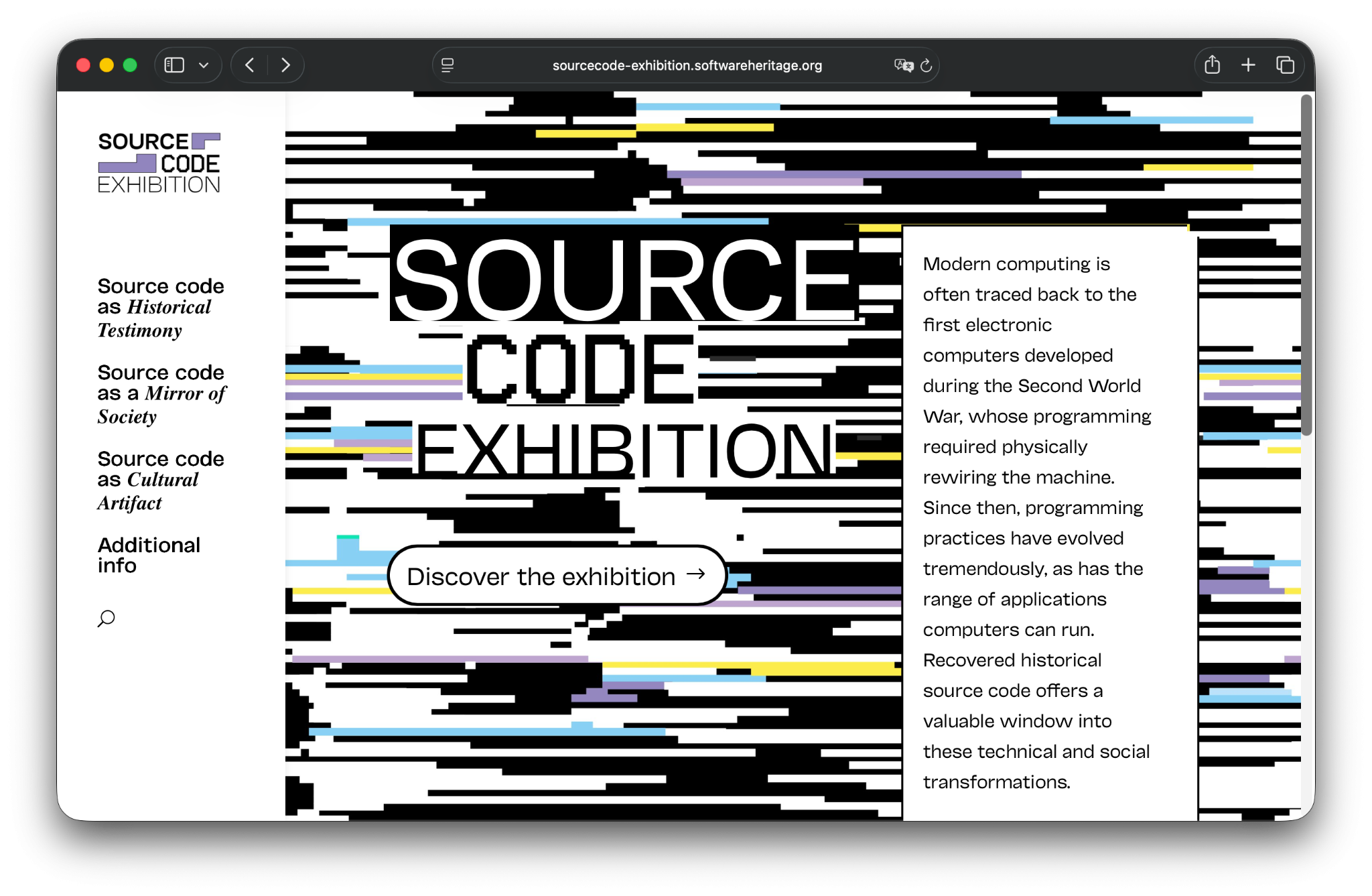
On January 29, 2026, Software Heritage and Inria will open a new exhibition at UNESCO Headquarters in Paris. The "Source Code Exhibition" presents fifteen code examples spanning seventy-five years of computing history. Each is interpreted by a different contributor—historians, artists, developers, activists. The exhibition takes an unusual approach: it treats source code as the central exhibit, not merely as contextual material for hardware or interfaces.
We are part of the organizing team, and we'd like to bring the project to this community: not as a finished argument, but as an invitation to critique, extend, and challenge the choices we've made.
Software Heritage: Preservation as Foundation
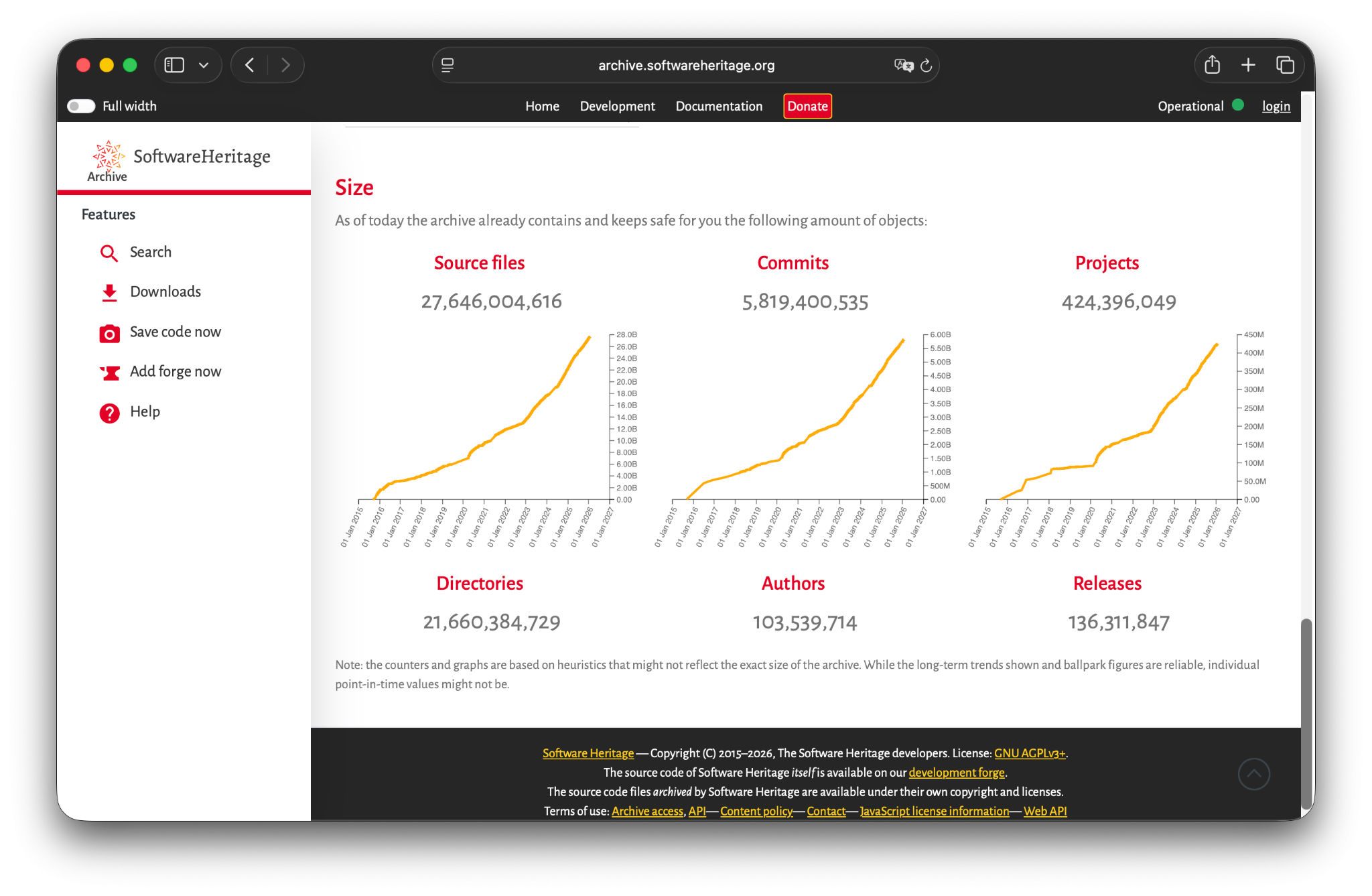
This exhibition grows from the work of Software Heritage, a nonprofit launched in 2016 with an ambitious mission: collect, preserve, and share all publicly available source code. Their archive now holds over 18 billion unique source files from more than 300 million projects—a Library of Alexandria for software.
But Software Heritage's vision goes beyond storage. As they put it: "Software in source code form is produced by humans and is understandable by them; as such it is an important part of our heritage that we should not lose." Code carries our technical and scientific knowledge. It mediates access to all our digital information—lose the software, and we lose the capacity to interpret what we've created. Software Heritage recognizes that preserving code is essential for preserving cultural heritage itself.
The exhibition marks Software Heritage's tenth anniversary. It experiments with what becomes possible when preservation meets interpretation. An archive makes code available; an exhibition asks what it means.
The Three Axes
The exhibition organizes its fifteen panels around three overlapping axes:

Source code as historical testimony — how recovered code offers windows into technical and social transformations, from the first programming textbook to ELIZA to XMODEM.
Source code as mirror of society — how code reflects and shapes the cultures that produce it, from a Saturday afternoon git commit to RSA encryption on a protest T-shirt.
Source code as cultural artifact — how code functions as an expressive, aesthetic form, from the thirteen-character fork bomb to programming in classical Chinese.
These aren't rigid categories; most panels resonate across multiple axes.
The Exhibition Online
The physical exhibition space at UNESCO limited us to fifteen panels. We received fifty-one proposals in response to our call for contributions. Selecting among them was difficult. We sought diversity—in time periods, programming languages, geographic origins, and contributors' relationships to code. The final selection reflects those priorities, but also inevitable compromises.
Our hope is that the online version will offer more flexibility. All panel texts, code examples, and contributor bios are available under a Creative Commons license. We aim at revisiting some of the initial proposals and welcome new contributions in the future. We encourage you to spend time with the materials before diving into discussion.
Visit: www.sourcecode-exhibition.softwareheritage.org
Starting the Conversation
Over the coming days, we'll post in-depth code critiques of exhibition panels for discussion, alongside a practical introduction to using Software Heritage as a research tool. But we wanted to open this week by inviting reactions to the exhibition as a whole—its premise, its choices, its gaps.
For instance: how do we best communicate the cultural significance of source code to a broader audience? Many visitors at UNESCO won't have written a line of code. What works, and what gets lost in translation? To paraphrase Benjamin, what is the exhibition value of source code?
Are the three axes we chose—historical testimony, mirror of society, cultural artifact—the right categories? Do they help or hinder interpretation? Are there any other categories that might seem relevant?
And more broadly: what can code learn from existing heritage practices, and what new heritage practices might code require?
We've also posted a companion thread on Software Heritage as a resource for code studies—how to navigate the archive, what's possible with their tools and APIs, and how researchers in this community might use it in their own work.
We look forward to hearing your thoughts—and to exploring the exhibition together.
Comments
Thanks for sharing (and creating) Really enjoying how explicit and direct the exhibit is (e.g. the 1995 munition T-shirt). I am particularly enlivened by the ways that the exhibit concretizes some of the conversation, while leaving room for future development and exploration via the website and this forum. The work (and analysis) continues; what fun!
I found it compelling that the front matter of the exhibition explicitly states for UNESCO visitors how the focus on source code is itself unusual, prompting reflection on the often-invisibilized nature of source code. The privileging of source code over an interface or hardware prompts reflection on the underlying infrastructural mechanisms that make many of the digital and technological tools we encounter in our daily lives. It calls to mind the important work of uncovering these hidden infrastructures, which Star notes are not as easily recognized by everyday users until they breakdown: “The normally invisible quality of working infrastructure becomes visible when it breaks: the server is down, the bridge washes out, there is a power blackout” (1999, p. 382). For everyday visitors at UNESCO, the absence of a GUI or schematic itself makes an argument for a more critical literacy around the material and social effects that source code can enact, so I appreciate this aspect of the exhibition’s pedagogical affordances. The political nature of many of the examples, notably including the RSA T-shirt, makes the importance of developing a critical awareness of these otherwise invisible texts all the more important. Similarly, the example of the segment cell nuclei code snippet illustrates how the affordance of scaling up the computational treatment of data, as evident in the ability to loop over images repeatedly and process them in the same way, means that minor changes have significantly larger effects as we continue to use those encoded underlying assumptions that are baked into research practice. Overall, I find that the explanatory descriptions for each included example offer a lot of room for reflection and further reading and investigation to a wide audience of visitors, and I could see this being used as a really great resource for students in STS classes to give them more of a sense of how code is both situated in the social, political, historical, and cultural, as well as an acting agent in shaping these aspects of daily life.
References
Star, S. L. (1999). The ethnography of infrastructure. American Behavioral Scientist, 43(3), 377-391. https://doi.org/10.1177/00027649921955326.
This has been a really rich treasure-trove of materials to explore - what an accomplishment!
The questions about the "exhibition value of code" and the three axes (historical testimony, mirror of society, cultural artifact) interlock in the sense that each axis presents a form of knowledge as a value proposition: you might care about exhibited code because...:
The hard thing for me about these keywords is that at a deeper level all three concepts are historical, all are societal, and all are cultural. If I understand the category explanations correctly then "Historical Testimony" is Big H History (large scale and era transitions), while Mirror of Society is more personal and interpersonal and focused more on moments in time rather than transitions, and the third category is aesthetics per se. Or, to be disciplinary, we might articulate the exhibition value of Code for Historians, Code for Sociologists, and Code for Artists a bit differently because each discipline constitutes knowledge a bit differently.
Thank you all for these generous and thoughtful responses.
The exhibition opened on January 29 and has now closed its doors at UNESCO—but we're delighted to share that it will travel next to the Cité des Sciences et de l'Industrie in Paris.
The exhibition will be installed at the Carrefour Numérique² beginning March 7, 2026, as part of the Premier Samedi du Libre XXL, and will remain on view through March 28. The Carrefour Numérique² is a collaborative space dedicated to digital technology, located on level -1 of the Cité des Sciences (30 avenue Corentin Cariou, 19th arrondissement). Admission is free.
We're also grateful to report that, thanks to our outstanding science outreach manager Camille Picard, we were able to film portions of the inauguration day and conduct interviews with several contributors who were present. We're enormously thankful to them for sharing their time and perspectives, and we hope to share some of this material in the coming months.
The exhibition is also available to travel. If you're interested in hosting it at your institution, please reach out to us at sourcecode-exhibit@inria.fr.
Now to the substance of your comments, which have given us much to think about.
@clairejcarroll, your observation about the exhibition's directness resonates with something we discussed often during the selection process. The RSA T-shirt, for instance, does its argumentative work without requiring explanation: the gesture of wearing encryption as clothing already makes the point about code-as-speech. At the inauguration, our contributor Stéphane Bortzmeyer brought with him the French version of the T-shirt, which adds another layer—one that unfortunately doesn't translate well to the online version of the exhibition. This was a useful reminder of the format's limitations: we were constrained to posters, and some dimensions of the code examples (physical objects, material contexts, linguistic particularities) inevitably get flattened in that translation.
@hmkinsle, thank you for introducing me to Susan Leigh Star's work on infrastructure—I wasn't familiar with it, and it opens productive lines of thinking for this project.
Your comment touches on something central to my own research on source code as a historical source. As I've argued elsewhere: every app, website, and digital service we use today is built on layers of code that capture decisions, assumptions, and values—traces historians are only beginning to learn how to read. Code is increasingly being recognized as cultural heritage, raising questions about how it should be preserved and what transformations occur as working software becomes historical artifact.
The exhibition's insistence on the centrality of source code is both its strength and its limitation. By foregrounding code over interfaces or hardware, we make visible what is usually transparent. But the poster format necessarily strips away much of the context that would enrich interpretation: the running program, the development environment, the material traces of use. We aimed to compensate through the contributor texts, but there is only so much a panel can hold.
@jeremydouglass, thank you for this reframing of the axes. They emerged during the call for proposals as a way to be as inclusive as possible—broad enough to welcome diverse submissions, while giving us criteria to navigate what turned out to be a very difficult selection process. We received fifty-one proposals of remarkable quality for fifteen slots, and the axes helped us ensure some balance across perspectives and periods.
I do agree that they risk flattening. ELIZA, for instance, operates simultaneously as historical testimony, mirror of society, and cultural artifact—the axes don't capture that multivalence so much as offer entry points into it. Our hope is that, taken together, the fifteen panels reflect something of the diversity of the world of source code: its languages, its contexts, its practitioners, its purposes. Whether we succeeded is, of course, for others to judge.
If code mirrors society, it means code is just a normal text which is pregnant of the coder's world views, ideology, activism, cultural heritage and any kind of human tendencies. Code has passed from displaying text on the screen to displaying the hidden intent of the programmer.
Hello, being myself in the organizing team, I can tell that a lot of discussion have been necessary to reach this point. The actual three parts division was not the only possible, obviously, but it permitted to categorize easily enough the proposals.
At a certain point I proposed a slightly different approach, that was probably too "theoretic" to be used, but I think it is worth speaking about here.
I'd start with 2 dimensions:
1. Role : functional vs symbolic
2. Context : internal vs external
A Functional: the code is interesting for its effects
A1 internal:
Society (code as comunication): the object is interesting for the role it had in shaking the (programmers’) opinions and ideas
A2 external:
Science (code as a tool): the object is interesting because it shows why programs are fundamental tools to understand the world
B Symbolic: the code is interesting in itself
B1 internal
Languages (code as a text): the object is interesting as a text written in some moment in some language, within certain constraints.
B2 external
Art and culture (code as art-piece): the object is interesting for what it suggests, for the relationships it draws with other languages/media
This leads to a four quadrants schema:
