Howdy, Stranger!
It looks like you're new here. If you want to get involved, click one of these buttons!
Categories
In this Discussion
2026 Participants: Martin Bartelmus * David M. Berry * Alan Blackwell * Gregory Bringman * David Cao * Claire Carroll * Sean Cho Ayres * Hunmin Choi * Jongchan Choi * Lyr Colin * Dan Cox * Christina Cuneo * Orla Delaney * Adrian Demleitner * Pierre Depaz * Mehulkumar Desai * Ranjodh Singh Dhaliwal * Koundinya Dhulipalla * Kevin Driscoll * Iain Emsley * Michael Falk * Leonardo Flores * Jordan Freitas * Aide Violeta Fuentes Barron * Erika Fülöp * Tiffany Fung * Sarah Groff Hennigh-Palermo * Gregor Große-Bölting * Zachary Horton * Dennis Jerz * Joey Jones * Titaÿna Kauffmann * Haley Kinsler * Todd Millstein * Charu Maithani * Judy Malloy * Eon Meridian * Luis Navarro * Collier Nogues * Stefano Penge * Marta Perez-Campos * Arpita Rathod * Abby Rinaldi * Ari Schlesinger * Carly Schnitzler * Arthur Schwarz * Haerin Shin * Jongbeen Song * Harlin/Hayley Steele * Daniel Temkin * Zach Whalen * Zijian Xia * Waliya Yohanna * Zachary Mann
CCSWG 2026 is coordinated by Lyr Colin-Pacheco (USC), Jeremy Douglass (UCSB), and Mark C. Marino (USC). Sponsored by the Humanities and Critical Code Studies Lab (USC), the Transcriptions Lab (UCSB), and the Digital Arts and Humanities Commons (UCSB).
#critcode Tweets
ELIZA at UNESCO
I recently attended the Software Heritage symposium and exhibition held at UNESCO headquarters in Paris. The event brought together researchers, archivists, and developers working on preserving the world's software source code. I thought it might be interesting to share some photographs from the day, although I should admit that it was MM who actually suggested I upload them  . The symposium offered a fascinating insight into our computational heritage has become of interest to UNESCO, and they are seeking to ensure it remain accessible for future generations.
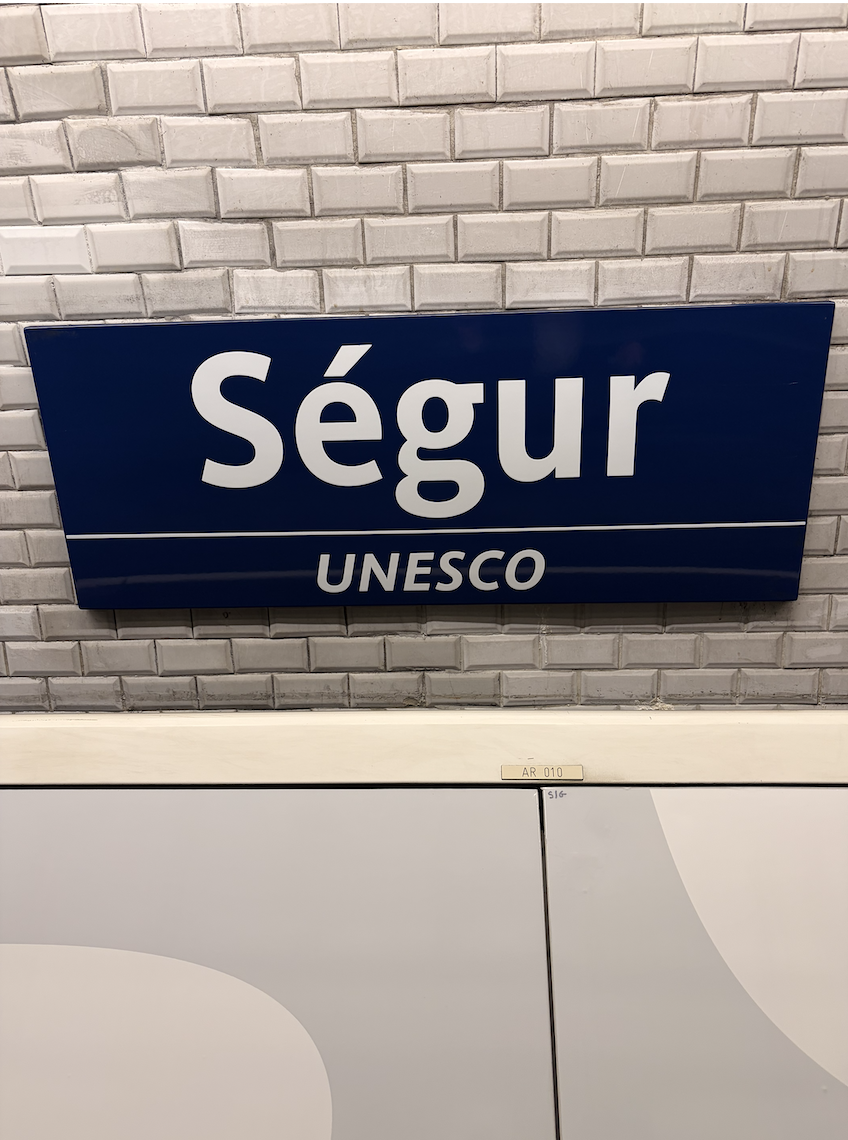
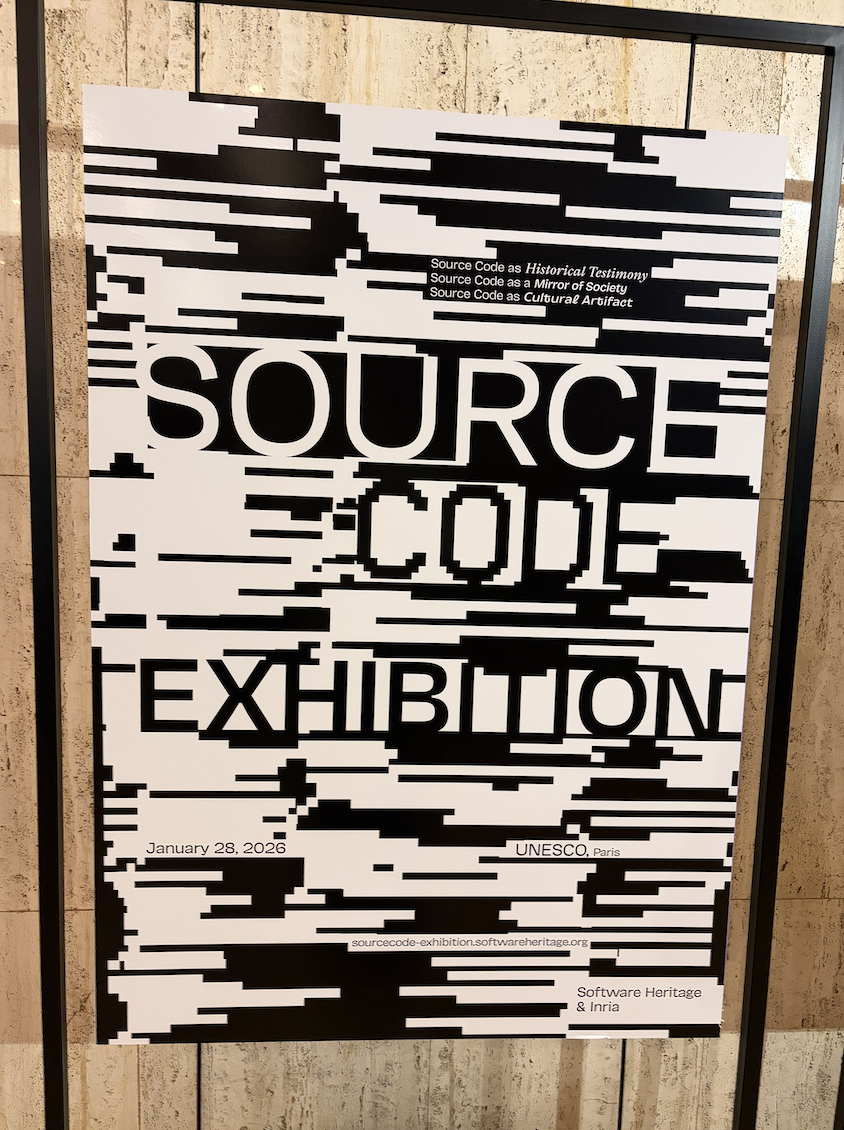
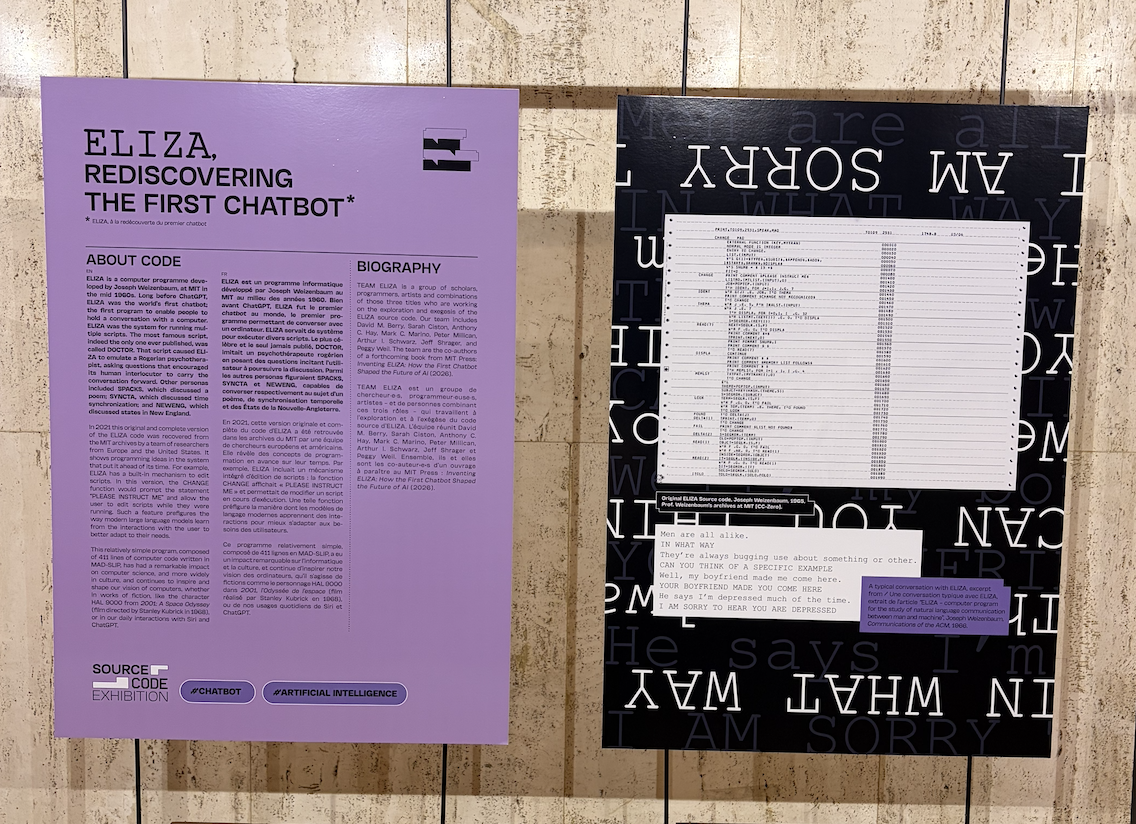
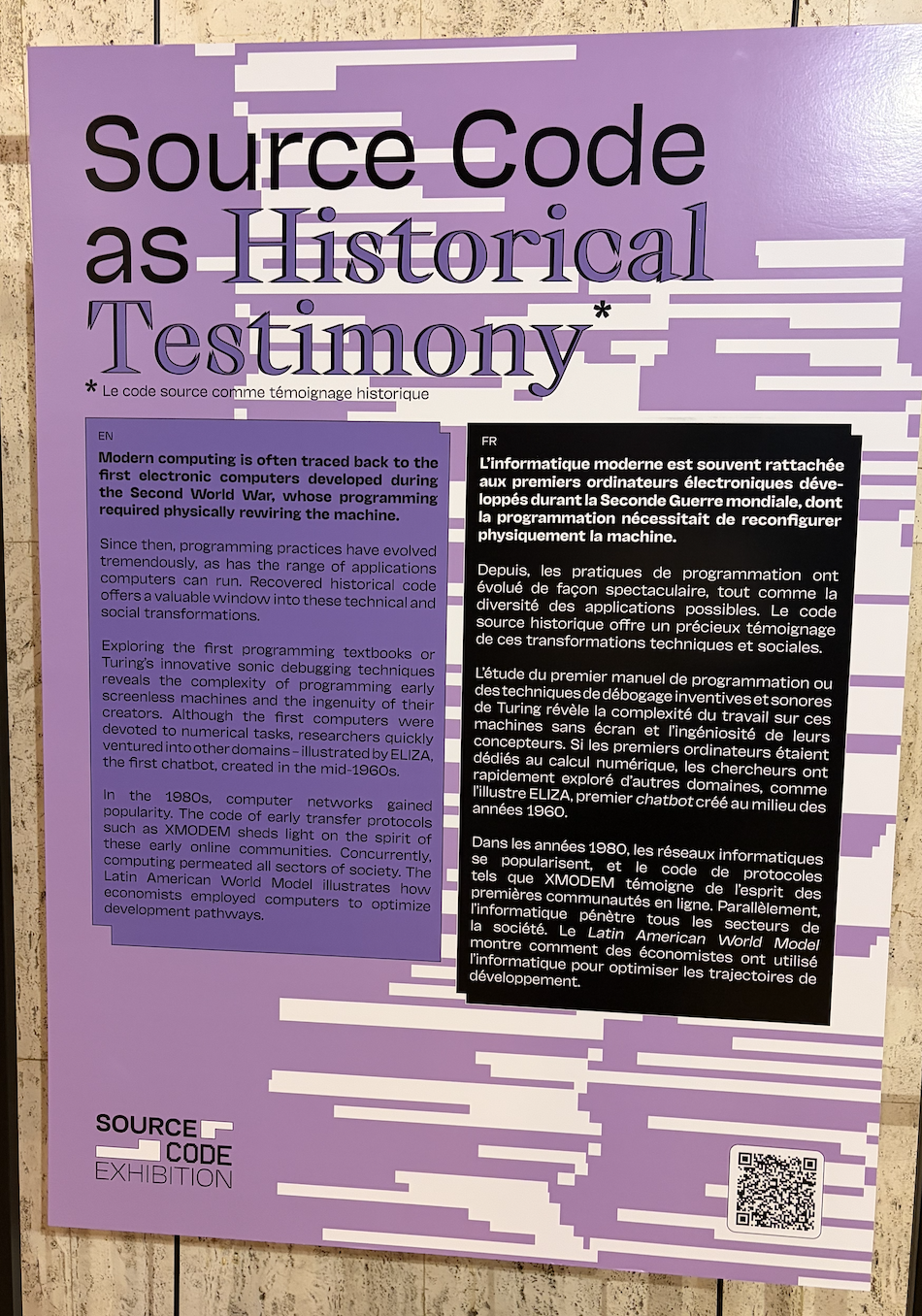
I have more but Eurostar WiFi isn’t what it was…
Comments
Thank you for posting these, @davidmberry , especially given that there is not a lot of press coverage online.
In addition to the Software Heritage post on the Source Code exhibit, according to UNESCO's the agenda for the Software Heritage Symposium and Summit, panels this year include:
@davidmberry What were, to you, some of the most interesting parts of the discussion? (Not just of ELIZA.) (hoping they’ll online the vids.)
Apropos CCS, TeamELIZA (the folks named on that poster) had a lively discussion (read: screaming at one another … not really … maybe a little :-) about what page of the code to submit since we could only send one page. The other leading candidate was to post the core of the ELIZA match-and-respond loop. What won out was this “Teacher” mode. Both represent novel and interesting code-level learnings that speak to different aspects of ELIZA. Here’s the core code (perhaps not edited quite as it might have been submitted). I’ve blighted the SLIP routines that do the matching and re-assembly work under the hood:
